
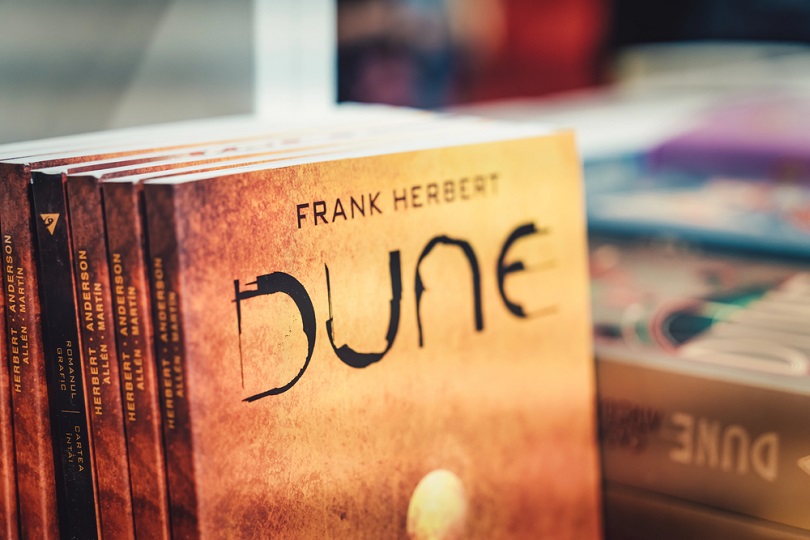
Arrakis was made to test the faithful, so the Fremen saying goes. So, too, can it test the comprehension of International Relations undergraduates grappling with questions of political theory. An 18 year old undergraduate studying in 2025 was born in 2007. How dare they be so young. Worse, I choose to teach them the writings of Ibn Khaldun, a man born in 1332. Worse still, those writings are about the politics of medieval North Africa, a region which my students have never studied, using concepts like ‘assabiyya which my students have never heard of. The good news: I am not teaching History, but International Relations Theory. As such, it is the dynamics of political change that are important, not the details of life and kingdoms in North Africa. I have used those dynamics in my own research, in an analysis of the contemporary Crisis of Liberal International Order (Sheikh and Thomas 2025), and more or less invite the students to do the same, to use classical political thought in the analysis of contemporary politics. Dune Part One came out in 2021 and won 5 Academy Awards. Dune Part Two came out in 2024 and won 2 Academy Awards. My students may know little about the Bedouin conquest of the Maghreb in the 12th century, but they are well aware of the battle of the fictional Fremen to repel the imperialist forces on their planet, Arrakis. If Saddam Hussein is as much a fictional character as Captain Kirk for students born in 2007, why not meet them where they are and illustrate political concepts through popular culture?
I’m not the only one who thinks so. The far right also utilise popular culture to animate their ideas – Elon Musk famously Tweeted an image from 1997’s Starship Troopers in support of his cuts to US government services (The Independent 2024). He was seemingly unaware that Starship Troopers is a satire of fascism (Child 2022). Or maybe he is aware and that is the point (Goodman 2025). So, bringing popular culture into the classroom is less a transgression on my part than it is meeting the current moment of politics and education through memes and TikTok. This type of work entered IR as ‘the aesthetic turn’ in 2001 (Bleiker 2001), and has had a prolific presence ever since (and even before) (Holden 2006; Grayson et al. 2009; Buzan 2010; Sachleben 2014; Crilley 2021; Weldes 1999).
So, when my 18 year old students come to the class on Ibn Khaldun in their first year of study on the BA International Relations programme at the University of Sussex, I ask them how many have seen Dune. 80% or more of the hands go up, and inevitably one hero says they have read the novel. It is short work to go from there, to watching the trailer of one of the films, or a short clip, and asking the students, in groups, to relate what they have seen or what they know of the films, to the preparatory reading they have done for class. This is incredibly useful conceptually, helping the students digest a text far removed from their previous education and knowledge, allowing them to make connections and develop an understanding they have earned themselves, through their own efforts in class. To explain how, you will have to indulge me as I take you through the plot and ideas of two books I love very much: Frank Herbert’s novel, Dune, published in 1968, and Ibn Khaldun’s scholarly text, Muqaddimah (Introduction), published in 1377.
Dune is an epic story of cosmic politics, prophecy, and treachery. A science fiction setting mixed with feudal political dynamics, the book chronicles the changing fortunes of House Atreides and its leader, Paul, as they settle on a desert planet, win the trust (or manipulate) the local population in order to conduct a war, or jihad in the language of local Fremen, against all the enemies of the Atreides. The Fremen are so effective an ally of Paul because they live hardy lives in the desert, far from the decadence of wealth. They are accustomed to hardship, and this is in part due to a faith in themselves, their mission, and their prophet (who, wouldn’t you know, is the first white man – in the film – to join their ranks. More on this at the end). Their hard lives make them superlative warriors, coupled with their sense of purpose, they are unstoppable and (spoiler) conquer the galaxy in the name of House Atreides. In Part 3, if the film follows even slightly the narrative of the next book, Dune Messiah, on which it is based (again, spoilers), this will all collapse spectacularly on Paul, as his people cast him out and resent the actions they have taken.
Muqaddimah is a work of history and sociology which explains the rise and fall of political dynasties based on the rise and fall of their ‘assabiyya, their group feeling. Groups in the desert are argued by Ibn Khaldun to be “closer to being good than sedentary people”, as a well as being brave (Ibn Khaldun 1958, 94), having strong leadership (1958, 138), and being more willing to accept religious imperatives (1958, 98). Because of these relative advantages, the people of the desert look on the decadence and moral decay of the rich, comfortable urban centres, and move to capture the city. Thus, a new dynasty is formed, and Ibn Khaldun describes the rise and fall of dynasties as an inevitable life cyle, a story in which ‘assabiyya breaks down and the new rulers become just as corrupt and ineffective as the old rulers, and a new group living the hard life of the desert look upon the city and move to capture it, beginning the cycle again (Ibn Khaldun 1958, 141–42).
Students are able to apply the dynamics of change, what Ibn Khaldun calls ‘umran, in the fictional world of Dune. In doing so, they are able to draw on their own resources, or “synthetic experiences” (Daniel and Musgrave 2017, 503), to make sense of Ibn Khaldun’s ideas. Synthetic experiences, “impressions, ideas, and pseudo-recollections about the world derived from exposure to narrative texts” (Daniel and Musgrave 2017, 503), furnish students with intellectual resources they can use to grapple with concepts and theories. This is more or less what Neumann and Nexon refer to as “Popular Culture as a Mirror” (Nexon and Neumann 2006, 10), one of four distinct approaches to Popular Culture in IR, where the fiction of Dune is the medium through which theory is explored. This is the pedagogical purpose in my class, but it is not the only thing we can do with Dune, as I will explore later.
What Dune allows students to discuss is the presence/importance of ‘assabiyya in political change. Can we see ‘assabiyya on screen in how the Fremen self identify as a group distinct from other factions on the planet Arrakis? Does leadership relate to ‘assabiyya, given the delicate relationship between Paul and the Fremen leader, Stilgar? Once these principles and concepts are better conceptualised through fiction, they can be applied to our world, looking at the fracturing ‘assabiyya of the Liberal World Order, and the emerging ‘assabiyya of rival groups seeking to conquer the ‘liberal dynasty’ (Sheikh and Thomas 2025, 1). Pop culture here has served an important pedagogical role in aiding understanding of an otherwise difficult text, giving it (fictional) context to aid learning.
I have to believe that Herbert read the Muqaddimah before writing Dune, the similarities jump off the page, perhaps most obviously in how the Fremen’s survival manual is called the Kitab al-Ibar (Herbert 2005, 637), the very same title of Ibn Khaldun’s historical encyclopaedia, for which the Muqaddimah is the introduction. Not to mention the overall ‘space Arab/Bedouin’ aesthetic of the Fremen, from their look (face tattoos, flowing robes) to their language (borrowing even more from Arabic in the books than the film). While Robert Irwin, author of Ibn Khaldun: An Intellectual Biography, claims that Herbert spoke in a radio interview about reading Ibn Khaldun (Irwin 2018, 200), this claim is not evidenced.
In another class, we can do more with pop culture. If how we conceive the world and its problems are as much a cultural production as it is analysis of ‘the facts’ (Bleiker 2001; Weldes 1999; Boaz 2020; Daniel and Musgrave 2017; Grayson et al. 2009), then pop culture, and Dune, become constitutive of political life (Nexon and Neumann 2006, 10). Now, rather than Dune being a medium through which we understand some other concept, Dune is the thing we are analysing. How is it that our space Arabs, the Fremen, have not one Arab actor in a speaking role? The Fremen are considered religious to a fault, their faith is manipulated towards violent ends. The Fremen are also a native resistance group to occupying powers. With all this in the mix, can we ‘read’ the film to learn about society’s depiction and production of Self and Other. The irrational, brown masses who need the guiding hand of their white saviour to make their inherent violence meaningful in wider politics.
My colleagues have had the misfortune of attending my Star Trek seminars at the University of Sussex. Here too is another great use of popular culture: it is a great leveller. It is intimidating to discuss topics with eminent experts who may have literally written the book on a given issue. The barrier of entry for interested researchers from neighbouring fields, postgraduate and undergraduate students, can be large. But with Star Trek (and pop culture in general) no-one is the expert. Bringing together IR researchers and students to watch a pop culture artefact and discuss its implications for theory and practice is a very accessible way to enter into these conversations, where professors and undergraduates find themselves in meaningful conversation with each other.
Bibliography
Bleiker, Roland. 2001. ‘The Aesthetic Turn in International Political Theory’. Millennium 30 (3): 509–33. https://doi.org/10.1177/03058298010300031001.
Boaz, Cynthia. 2020. ‘How Speculative Fiction Can Teach about Gender and Power in International Politics: A Pedagogical Overview’. International Studies Perspectives 21 (3): 240–57. https://doi.org/10.1093/isp/ekz020.
Buzan, Barry. 2010. ‘America in Space: The International Relations of Star Trek and Battlestar Galactica’. Millennium: Journal of International Studies 39 (1): 175–80. https://doi.org/10.1177/0305829810371016.
Child, Ben. 2022. ‘Nazis in Space: How Paul Verhoeven’s Starship Troopers Brilliantly Skewered Fascism’. Film. The Guardian, November 12. https://www.theguardian.com/film/2022/nov/12/nazis-in-space-how-paul-verheovens-starship-troopers-brilliantly-skewered-fascism.
Crilley, Rhys. 2021. ‘Where We At? New Directions for Research on Popular Culture and World Politics’. International Studies Review 23 (1): 164–80. https://doi.org/10.1093/isr/viaa027.
Daniel, J Furman, and Paul Musgrave. 2017. ‘Synthetic Experiences: How Popular Culture Matters for Images of International Relations’. International Studies Quarterly 61 (3): 503–16. https://doi.org/10.1093/isq/sqx053.
Goodman, Emma. 2025. ‘Elon Musk’s Nazi Salute, George Orwell and Five Lessons from Past Anti-Fascist Struggles – Media@LSE’. Media@LSE – Promoting Critical Research into the Vital Role of Media and Communications in Contemporary Society, February 4. https://blogs.lse.ac.uk/medialse/2025/02/04/elon-musks-nazi-salute-george-orwell-and-five-lessons-from-past-anti-fascist-struggles/.
Grayson, Kyle, Matt Davies, and Simon Philpott. 2009. ‘Pop Goes IR? Researching the Popular Culture—World Politics Continuum’. Politics 29 (3): 155–63. https://doi.org/10.1111/j.1467-9256.2009.01351.x.
Herbert, Frank. 2005. Dune 1: Dune. Ace.
Holden, Gerard. 2006. ‘Cinematic IR, the Sublime, and the Indistinctness of Art’. Millennium 34 (3): 793–818. https://doi.org/10.1177/03058298060340031501.
Ibn Khaldun. 1958. The Muqaddimah: An Introduction to History. Translated by Franz Rosenthal. Pantheon Books.
Irwin, Robert. 2018. Ibn Khaldun: An Intellectual Biography. Princeton university press.
Nexon, Daniel H., and Iver B. Neumann. 2006. Harry Potter and International Relations. Rowman and Littlefield.
Sachleben, Mark. 2014. World Politics on Screen : Understanding International Relations through Popular Culture. The University Press of Kentucky.
Sheikh, Faiz, and Owen David Thomas. 2025. ‘Dynastic International Relations: Understanding Race and the Crisis of Liberal Order through Ibn Khaldun’. European Journal of International Relations, May 13, 13540661251338216. https://doi.org/10.1177/13540661251338216.
The Independent. 2024. ‘Elon Musk Roasted after Missing “Painfully Obvious” Message from 1990s Sci-Fi Classic’. November 19. https://www.independent.co.uk/arts-entertainment/films/news/elon-musk-trump-starship-troopers-meme-b2649528.html.
Weldes, Jutta. 1999. ‘Going Cultural: Star Trek, State Action, and Popular Culture’. Millennium 28 (1): 117–34. https://doi.org/10.1177/03058298990280011201.
Further Reading on E-International Relations